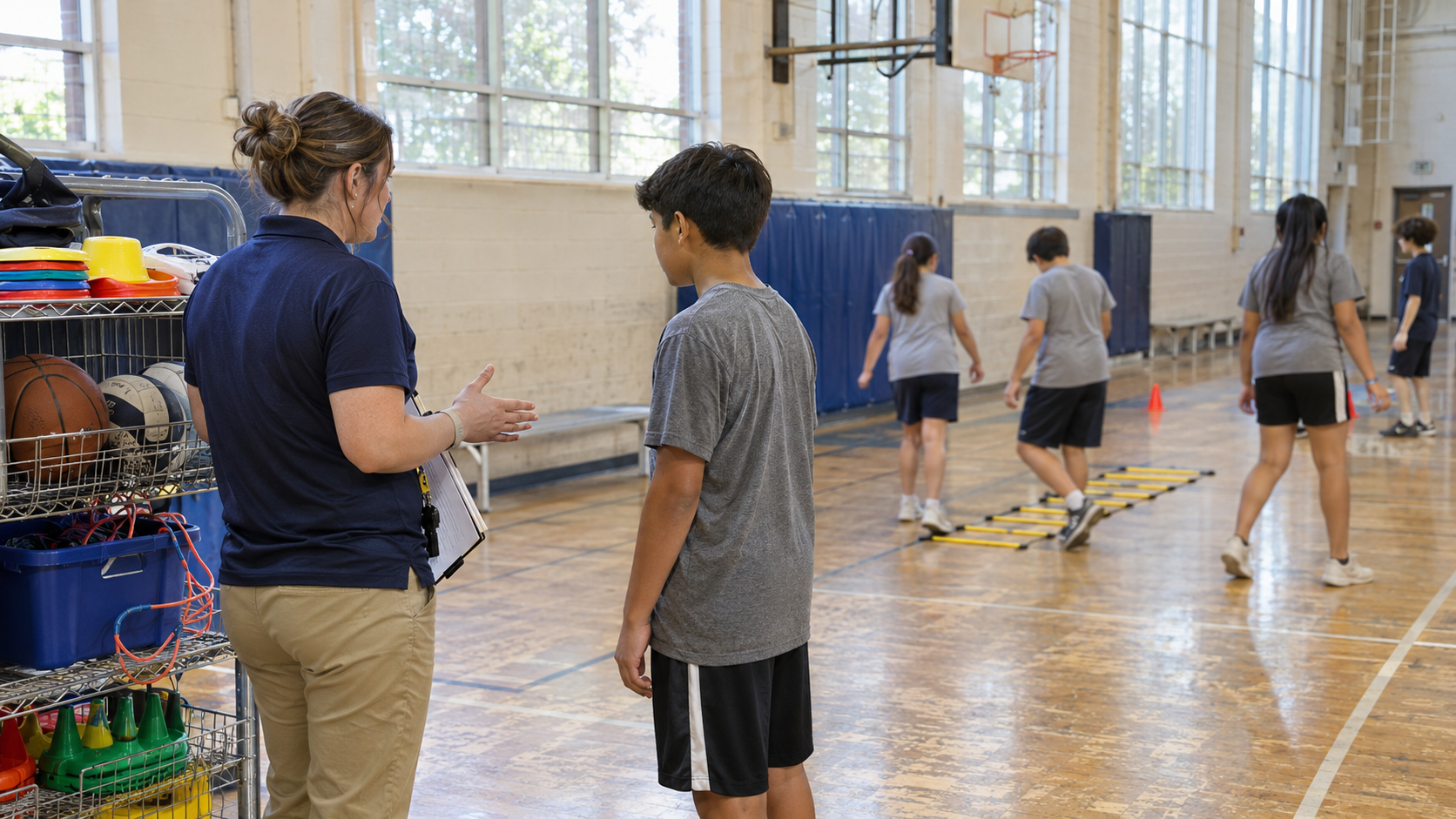
A student keeps bouncing a ball while directions are being given. Two students argue about a call. Another student stands at the edge of the activity and does not join in.
Those situations may interrupt the same lesson, but they do not necessarily need the same response.
Start with what you can observe. Then decide what needs to happen next to keep students safe and return them to learning. A long argument across the gym rarely gives the teacher better information or gives students more practice.
Check the situation before choosing the response
Off-task behavior describes what a student is doing. It does not explain why it is happening.
Before assuming a student is choosing to be difficult, check whether they understand the directions, can access the task, and feel safe participating. A crowded station, unclear role, difficult skill, peer problem, or communication barrier may need an instructional adjustment. Pain, breathing difficulty, or other health concerns need the appropriate health response.
Keep that check brief and private when possible: “Show me where you are starting,” or “What do you need help with?” A student may be able to demonstrate understanding more clearly than explain it in front of the class.
Check the lesson design, too. If several students are waiting in one line with nothing to practice, changing the arrangement may be more useful than repeating a reminder to pay attention.
Teach the routine before you need to correct it
“Use equipment safely” needs a demonstration.
Show students what the stop signal means for the equipment in their hands. Identify where equipment rests, where students wait, and how they ask for help. Let them rehearse the routine before adding the activity’s other demands.
The language should fit the students. An elementary class may need a visual cue and a short demonstration of where a ball rests. A secondary class can help identify a workable transition routine, then demonstrate that it protects others’ space. Use accessible signals and alternatives for students who cannot hear, see, or physically perform the standard routine.
This is part of PE instruction. SHAPE America’s 2024 standards include responding to directions in the early grades (3.2.4), increasing independence with safety in grades 3–5 (3.5.4), appropriate equipment use in grades 6–8 (3.8.7), and applying safe participation practices in high school (3.12.6). Select the indicator for your class; a single routine does not establish overall proficiency. Official PE standards
Correct the action clearly
For a low-level disruption, give one calm direction that describes the expected action. Use a private voice when practical and allow a reasonable opportunity to respond while continuing to supervise the class.
For example: “Place the ball in the equipment spot.” Once that happens, give the next needed direction. Avoid stacking several corrections into one speech. PENT’s behavior guidance supports brief, respectful prompts that identify the action expected of the student and follow-up acknowledgment when it occurs. PENT: PROMPT Method
The follow-up should be specific: “You put the ball down and left the passing lane clear.” That tells the student what helped. Adapt the acknowledgment to the student; public attention is not helpful for everyone.
Give a workable route back into the task
If the student is struggling to start, offer a choice you can actually support: “You can begin with this larger target, or I can show the first attempt again.” Both options should serve the lesson’s learning goal.
For an argument during a game, stop the disputed play safely. Use the resolution routine students have been taught, then restart. If the disagreement reflects a rule students do not understand, reteach that rule. If it involves bullying or harassment, follow the school’s response procedures; do not treat it as a routine disagreement to settle between students.
A brief, supervised reset may be appropriate under the student’s plan and school procedures. Explain where it occurs, who supervises it, and how the student returns. It should not become an indefinite place on the sideline or require a public apology before instruction can resume.
Do not assign laps, push-ups, or other exercise as punishment, or withhold PE as punishment. CDC recommends policies that prohibit those practices. A necessary safety interruption is different from making loss of learning the disciplinary goal. CDC: PE and physical activity strategies
Know when the situation needs more support
If equipment use or behavior presents immediate danger, stop the affected activity and use the school’s safety response. Maintain supervision, protect other students’ space, and call designated support as required. Do not continue ordinary redirection steps while waiting for a dangerous situation to become manageable.
Use established school procedures and any applicable individual support, behavior, or health plan. This article does not teach physical intervention. The Center on PBIS emphasizes planning and instructional supports to reduce reliance on reactive, exclusionary responses. Center on PBIS: De-escalating student behavior
When the same difficulty keeps returning, record what happened before the behavior, the observable action, the response, and what happened afterward. Bring the pattern to the appropriate school team. A brief observation can guide a question; it cannot establish the reason for a behavior or replace an individual assessment.
Free resource: PE Reset and Return Planner
Use this planning sheet to prepare one routine before your next lesson. Print this section or copy it into your lesson notes. Follow school policy and applicable student plans. For immediate danger, use the school safety response and designated support rather than this routine.
Prepare before class
Class/grade: __________________ Activity: __________________
One observable routine to teach: __________________________________________________________________
How I will demonstrate it and let students rehearse: __________________________________________________________________
Accessible stop signal and equipment resting location: __________________________________________________________________
How I will check understanding and task access: __________________________________________________________________
One brief, respectful prompt naming the expected action: __________________________________________________________________
An instructional adjustment I can offer while preserving the learning goal: __________________________________________________________________
Specific, student-appropriate acknowledgment when the action occurs: __________________________________________________________________
If a supervised reset is appropriate: location, supervision, and clear return step: __________________________________________________________________
How I will keep the rest of the class supervised: __________________________________________________________________
School procedure/designated support to use if safety is at risk or difficulty persists: __________________________________________________________________
Record what happened
Complete factual notes privately in the school-approved system. Do not upload identifying student information into a general planning tool without school authorization.
Before the behavior (task, transition, equipment, directions): __________________________________________________________________
Observed action (what was seen or heard; avoid labels or assumed motives): __________________________________________________________________
Adult response and support offered: __________________________________________________________________
What happened next, including return to instruction: __________________________________________________________________
What I will reteach, change, or refer to the school team: __________________________________________________________________
Teacher checks
- Have I separated routine off-task behavior from health, access, bullying, or urgent safety concerns?
- Does the response follow school procedures and the student’s applicable support plan?
- Does the student have an accessible way to demonstrate the expected behavior?
- Is the return step clear, supervised, and connected to instruction?
- Am I avoiding punitive exercise and loss of PE as punishment?
This is a planning aid, not a behavior diagnosis, crisis protocol, or substitute for individual assessment. Align the routine to the class’s grade-appropriate PE learning goals.
Teachers can explore WellnOS when preparing lesson materials. Review every resource against the students, equipment, school procedures, and learning goal before using it.
The response should make the next step clear: what needs to change, what support is available, and how the student can return to learning safely.