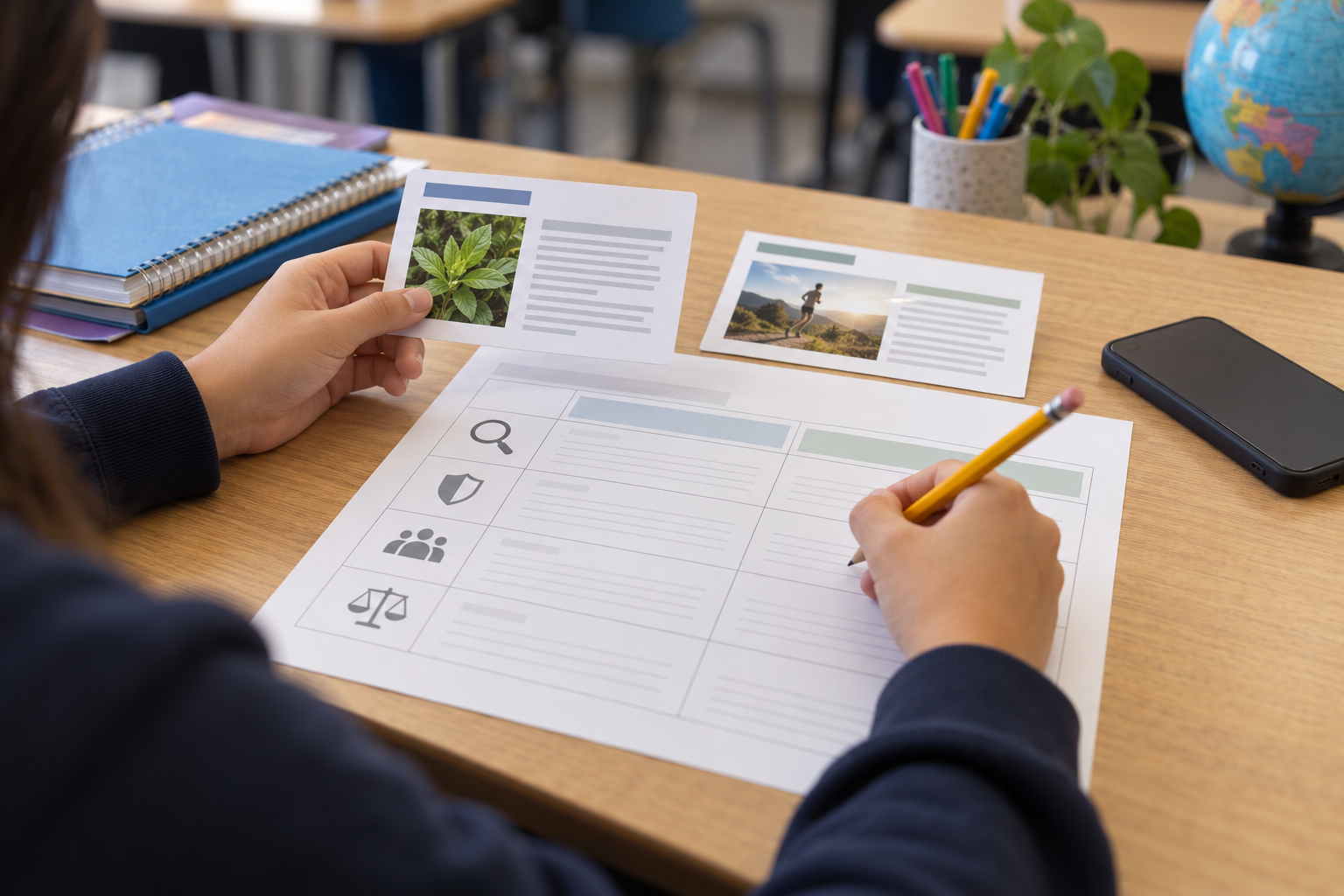
A confident voice and a large following can make a health claim sound convincing. Neither tells a student whether the advice applies to them.
That is a useful place to start a middle school health lesson. Give students a claim they might encounter online, then teach them how to check it before accepting it or passing it along.
The goal is more specific than telling students to “use reliable sources.” They need practice identifying the claim, locating the original information, checking the intended age group, and explaining what the evidence does and does not support.
This 40-minute lesson uses sleep information to practice those skills. The task stays focused on fictional examples. Students do not have to disclose their sleep habits, health conditions, family routines, or social media accounts.
Start with a claim worth checking
Display this teacher-created example, clearly marked as fictional:
“Every middle school student needs exactly eight hours of sleep. One number works for everyone.”
Ask students what they would need to know before sharing it. Who made the claim? What evidence supports it? Does “middle school” identify an age group precisely enough? What does the word “exactly” suggest?
Middle school classes can include students on both sides of an important age boundary. CDC lists 9–12 hours of sleep daily for ages 6–12 and 8–10 hours for ages 13–18. Those are ranges, not one exact target for every student. The distinction gives students something concrete to check. CDC: Sleep and Health
Keep the discussion about the claim. A student should not need to explain why their home situation makes sleep difficult to demonstrate the skill of evaluating information.
Teach a process students can repeat
Use four questions:
1. What is the exact claim? Separate what the message says from what the reader assumes it means. 2. Who is responsible for the information? Look for an identifiable organization or author with relevant expertise. A badge, professional-looking design, or large audience is not enough. 3. What does the original source actually say? Check the age group, date, evidence links, and important qualifications. Follow the reference when it is available. Two pages repeating the same recommendation are not necessarily two independent pieces of evidence. 4. What should happen before this is shared? Decide whether to correct the statement, withhold it while checking, or ask for help finding understandable information.
Students should also consider access. Can they read and navigate the source? Is a translation or read-aloud needed? Does it require an account or payment? A useful source may still need support before a particular student can use it.
National standards connection
The lesson supports SHAPE America’s 2024 National Health Education Standards, specifically 3.8.4, through examination of a health source’s credibility and usability, and 3.8.5, through practice responding to misleading information. These are lesson connections, not a claim that one worksheet establishes proficiency. SHAPE America official 2024 National Health Education Standards
A 40-minute middle school health lesson
Objective: Given a fictional health claim and a source, students will identify the claim, compare it with age-specific evidence, note one access consideration, and explain whether to correct, withhold, or seek help before sharing it.
Materials: Projected or printed fictional post; CDC source or accessible teacher-prepared copy; student sheet below; pencils. Devices are optional.
Observable evidence: A student names a specific detail from the source, explains how it relates to the claim, identifies one barrier/support, and gives a reasoned next step.
Minutes 0–5: Identify the claim. Display the fictional sleep post. Students underline its main statement and circle a word that needs checking. Collect a few responses without asking anyone to describe their own sleep schedule.
Minutes 5–12: Model the check. Open CDC’s Sleep and Health page or use a teacher-prepared source packet with the title, organization, date, URL, age table, and references preserved. Show how to locate the age ranges and distinguish a recommendation from a guarantee. Model a brief conclusion using evidence from the page.
Minutes 12–24: Work through the free resource. Pairs analyze the fictional post and compare it with the source. Each student records an explanation. Include one access barrier and a practical support. For example, a difficult term could be defined with teacher help; a printed page could replace a live website when devices are unavailable.
Minutes 24–32: Respond responsibly. Students write a correction for a fictional class discussion board. It must fix the misleading statement, identify the source, and avoid commenting on another person’s habits. Partners check whether the correction answers the original claim rather than changing the subject.
Minutes 32–37: Try a new version. Present a second fictional post: “A sleep recommendation describes a range, so the original eight-hours-for-everyone post is close enough to repost.” Students independently explain what they would do and why. This checks whether they can apply the process beyond copying the teacher’s example.
Minutes 37–40: Collect an exit response. Ask: “What specific detail changed your judgment, and what would you do before sharing the post?” Use the answer to identify students who still need help connecting evidence to a conclusion.
Assess the explanation
Look for the student’s ability to name the misleading feature, use relevant evidence, consider whether the information is accessible, and select an appropriate response. “CDC is reliable” is a starting point. A stronger answer identifies the specific age ranges, notices that the claim says “exactly,” and explains why that wording matters.
Do not award points for students reporting ideal sleep habits. This is an information-evaluation lesson. Students may respond orally, dictate, use translated prompts, or work with enlarged text while demonstrating the same thinking.
The lesson also gives teachers a chance to explain where classroom information stops. General sleep recommendations do not diagnose an individual problem. A student with a personal concern can seek support privately from a trusted adult, school nurse, or health professional.
Free resource: Health Claim Check
Grades 6–8 | Student sheet and teacher key | Copy or print from this article
Name: ________________ Date: ________
Fictional classroom post — not health advice
“Every middle school student needs exactly eight hours of sleep. One number works for everyone.”
This post was invented for this lesson. It has no identified author, publication date, research link, or evidence. Do not share it as factual advice.
Source to check
CDC, Sleep and Health, September 10, 2026. https://www.cdc.gov/healthy-schools/sleep/index.html
Teacher-prepared summary of relevant information: CDC recommends 9–12 daily hours of sleep for ages 6–12 and 8–10 for ages 13–18. The page cites the American Academy of Sleep Medicine consensus statement. These are general age-based recommendations, not a diagnosis or an exact requirement for every individual.
Use the live page or the teacher’s accessible source packet to check this summary. The packet should preserve the organization, title, publication date, URL, relevant table, and reference information.
Check the claim
1. Write the post’s exact claim in your own words.
________________________________________________________________
2. Record the recommendations for ages 6–12 and 13–18. Which words in the post conflict with that information?
______________________________________________________________ ______________________________________________________________
3. Who is responsible for the source? What relevant expertise or evidence trail can you identify? A familiar logo alone is not your explanation.
________________________________________________________________
4. Identify one feature that might make the source difficult for a student to use. Name a support that would help.
________________________________________________________________
5. Write a correction for a fictional class discussion board. Use the age ranges, identify your source, and keep the response respectful. Do not discuss classmates’ habits.
______________________________________________________________ ____________________________________________________________ ______________________________________________________________
6. Would you share the original post? Explain your next action using specific evidence.
________________________________________________________________
Independent exit prompt
A second fictional post says: “A sleep recommendation describes a range, so the original eight-hours-for-everyone post is close enough to repost.”
What would you do before sharing it, and why? Use a specific detail from the source.
______________________________________________________________ ______________________________________________________________
---
Teacher Key and Notes
Purpose: Evaluate health information and practice managing a misleading message. Do not collect personal sleep histories. Responses can be written, oral, dictated, or otherwise accessible.
1. The post asserts one exact sleep amount applies to all middle school students. 2. Ages 6–12: 9–12 hours daily. Ages 13–18: 8–10 hours daily. “Every,” “exactly,” and “one number” erase age distinctions and ranges. Middle school is not an age category in the source. Students do not need to infer anyone’s personal sleep need. 3. CDC is the responsible public health organization. The age table identifies recommendations and references a relevant sleep-medicine consensus statement. Students should inspect attribution and the cited evidence rather than rely only on the organization’s name. The page’s September 10, 2026 date is contextual information, not proof of accuracy by itself. A source being recent, popular, or well designed does not establish that a particular claim is supported. 4. Accept concrete barrier/support pairs: vocabulary/definition; small print/enlargement; reading demands/read-aloud; language/checked translation; device or internet access/printed source packet. Do not assume one format meets every student’s needs. 5. Example correction: “The recommendation depends on age. CDC lists 9–12 daily hours for ages 6–12 and 8–10 for ages 13–18. That does not support one exact number for everyone. Source: CDC, Sleep and Health.” Other accurate, respectful answers are acceptable. 6. Withhold the original misleading post, correct it with attribution, or ask for help checking the evidence. Not sharing is appropriate; students are not required to publish anything or confront another person online.
Exit response: A range does not support a universal exact number. Eight hours is below the listed range for ages 6–12, while it is one point within the range for ages 13–18. Students should not repost the original as accurate; they should check and correct its wording or withhold it.
Quick formative review
- Evidence: Identifies a relevant age range and the precise mismatch with the claim.
- Source and access: Explains at least one specific credibility consideration and a practical barrier/support pair.
- Response: Chooses an appropriate next action and supports it with evidence rather than popularity or personal opinion.
Mark each as clear / needs support / not yet observed. Use a brief follow-up where evidence is missing. Do not score students’ personal sleep practices.
Standards connection: SHAPE America 2024, grades 6–8, 3.8.4 and 3.8.5. The source-check task supports credibility and access analysis; the correction/withholding task practices a response to misleading information. One lesson is not evidence of overall proficiency.
Source note: General sleep recommendations come from CDC, Sleep and Health, dated September 10, 2026, checked October 30, 2026. https://www.cdc.gov/healthy-schools/sleep/index.html
Students need opportunities to slow down, check a claim, and explain their judgment. That is a health skill they can use well beyond this lesson.
Teachers can explore WellnOS when preparing health education materials. The teacher still needs to review the content, reading demands, sources, and assessment before using a resource with students.