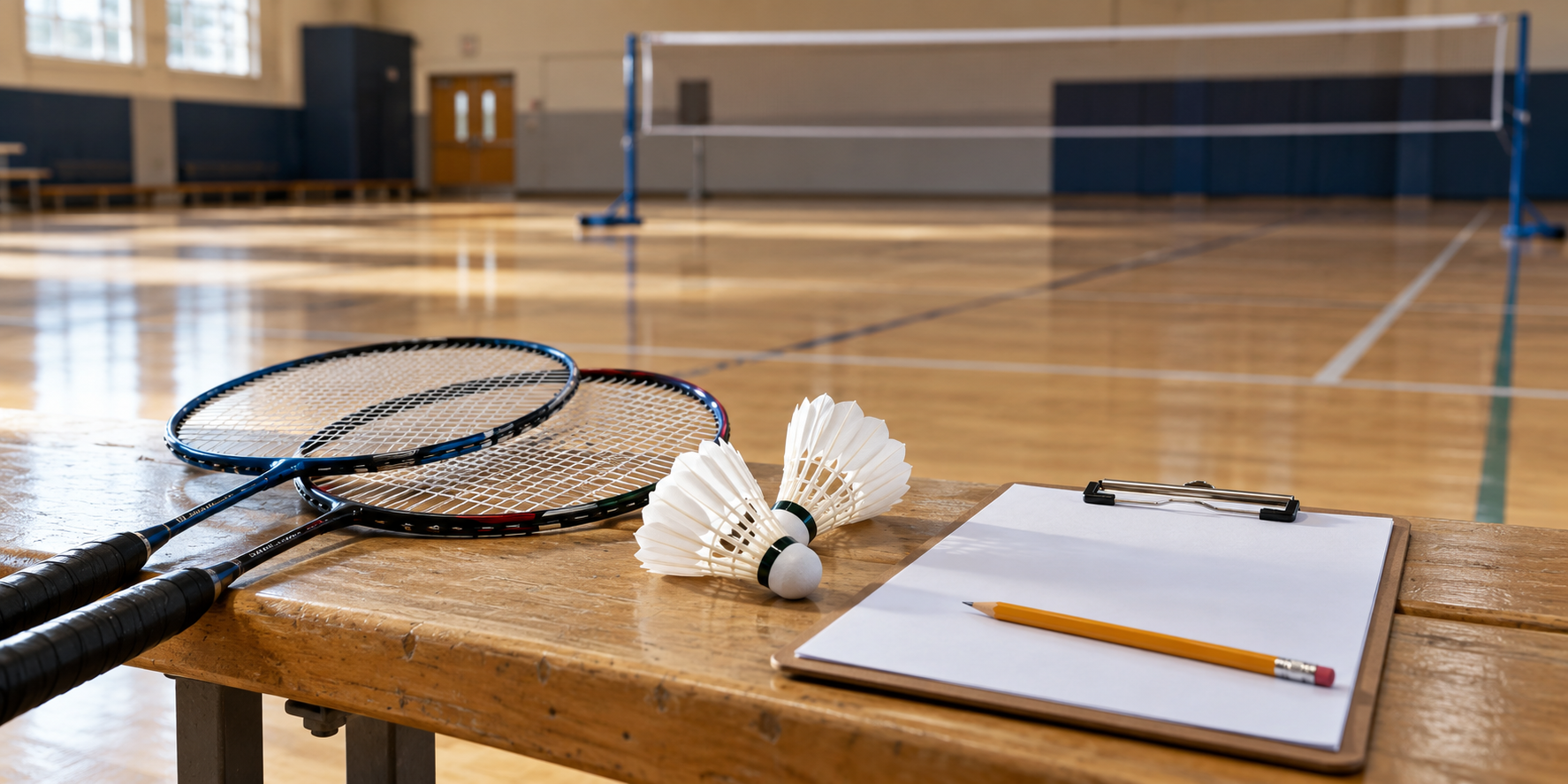
Grades 9–12. This lesson assumes students have already been taught safe, controlled badminton underhand serves and forehand target sends.
A student can complete a lot of repetitions without knowing what those repetitions are meant to change.
In high school PE, students should have opportunities to make more of those decisions themselves. What does the first attempt tell them? Which part of the skill needs attention? What will they practice, and how will they check whether it helped?
Those questions give a familiar badminton activity a useful purpose. The task is to build a practice plan, use feedback, and compare two sets of attempts under the same conditions. The score provides information. The student’s explanation shows how they are using it.
The task: choose a focus, practice, and check again
Students select a skill from two previously taught options: a controlled underhand serve or a controlled forehand target send from a self-dropped shuttle. Both direct the shuttle toward a marked target, with no opponent or return shot. The underhand serve is the planning example below. This is a modified accuracy task, not a regulation singles service test. Students work from a teacher-approved starting line toward a target placed within their safe practice lane. A shuttle landing inside or touching the marked target counts as a target hit for this activity. The teacher approves each selection for the available space before students begin. Keep the selected skill the same for baseline and retest. If a second skill cannot be offered safely, use a single-skill lesson and describe it as preparation toward the self-selected-skill indicator.
The teacher selects safe distances and target sizes appropriate to the class and available space. Students can choose an approved level of challenge before the baseline, such as a larger target or a shorter distance. Record that setup and keep it for the retest. A student who needs a different movement task should use an accessible, teacher-taught option with its own consistent baseline and retest conditions.
Offer two or three familiar cues from previous instruction rather than a long list of new corrections. Examples might include a controlled racket action and a consistent contact point. Students select one cue with teacher guidance. Avoid trying to rebuild several parts of a movement in one class.
The learning target is clear: I can use information from my attempts and a partner’s feedback to plan practice, then explain what the results suggest.
How this connects to national PE standards
SHAPE America’s 2024 high school indicators include developing goals and a practice plan for a self-selected skill (2.12.6), and independently providing and implementing feedback to improve performance (3.12.4). This lesson gives students evidence to work toward those indicators through a choice between previously taught skills, a recorded plan, and specific peer observations that students use in subsequent attempts.
The standards describe broader learning across instruction. One class does not establish proficiency in either indicator. See the official national PE standards and grade-span indicators.
Equipment and organization
For 24 students, plan for 12 pairs, 12 rackets, 12 shuttles, floor tape or flat markers, and one planner per student. Establish 12 practice lanes only if the space allows safe separation between every racket swing, landing area, and retrieval path. The number of lanes follows the space available; it is not a requirement to squeeze 12 lanes into a gym.
Partners take turns performing the selected skill and observing. The observer stays in a designated position behind and outside the server’s swing space, never in the landing area. There are no return shots. Send one shuttle, place the racket down, and retrieve only on the teacher’s signal when all rackets are still. Return to starting positions before the next signal. Include the retrieval route in the demonstration.
If only six lanes fit safely, assign two pairs to each lane and alternate active and observation roles in teacher-timed blocks. Keep only one performer active per lane. Allow more time or finish the retest next class if students cannot complete the work calmly. Do not shorten the safety routine to protect the schedule.
A 40-minute lesson
Minutes 0–4: Warm up and rehearse. Begin with comfortable movement in personal space, shoulder and trunk movements, and slow racket-action rehearsals without shuttles. Briefly revisit the learning target, previously taught skills, one useful feedback statement, and the stop-and-retrieve routine. Equipment and lanes should be set out before class. Confirm every student can use the selected task safely; allow more preparation time when needed.
Minutes 4–9: Collect a baseline. Each student completes five attempts of the selected skill from the recorded starting line toward the recorded target. Partners tally target hits and observe one agreed cue. Switch roles so both students have evidence. Five attempts provide a small starting sample, not a stable measure of ability.
Minutes 9–13: Make a plan. Students identify a specific need from the baseline and select one approved cue. A student might write, “My contact point changed between attempts. I will use the same setup before each serve and ask my partner to watch that cue.” The goal should be achievable within the practice time and connected to something observable.
Minutes 13–25: Practice and adjust. Give partners equal practice time. After a short set, the observer describes what happened using the agreed cue. “Your setup looked consistent on three attempts” provides more useful information than “Good job.” The performer uses the observation to select an adjustment, tries it, and tells the partner what changed. Use the final exchange and subsequent attempts without individual teacher prompting to collect evidence of independently giving and applying feedback; offer support afterward where needed. Students may adjust one practice condition, such as using a larger target, while keeping other conditions steady. They record the change and its purpose. Changing a practice condition is allowed; changing the retest conditions would make the comparison less useful.
Minutes 25–30: Repeat the original task. Restore the original target, starting line, and scoring definition. Each student completes five retest attempts. Partners record results and the same cue observation. Do not quietly move a struggling student closer and then treat the new score as improvement on the original task.
Minutes 30–36: Explain the evidence. Partners compare results and discuss the cue. Did accuracy change? Did the movement observation change? Did those two pieces of information agree? A lower score can still produce a useful explanation and a sensible next step. Avoid claiming that a small increase proves lasting learning.
Minutes 36–40: Submit a next step. Students complete the planner and explain what they would keep or change in the next lesson. The teacher reviews a manageable sample of partner exchanges during practice and uses the completed planners to decide what needs follow-up.
What to assess
Look for a plan connected to baseline evidence, feedback about an observable action, and an interpretation that uses the recorded conditions and results. Do not grade students on whether five retest attempts beat five baseline attempts. Prior experience, access needs, and normal variation affect those numbers.
Provide a visual model, short cue card, translated keywords, or an oral response option when useful. Students can dictate their explanation or use a teacher-approved recording method. Assessment should capture the intended planning and feedback skills without making handwriting or an inaccessible movement the barrier.
Free resource: baseline, practice, and retest planner
This planner was adapted and reviewed in WellnOS. Copy it into a document and print it for your class. No account is needed to use the version below.
Grades 9–12 • Choice of previously taught badminton target skills • Free WellnOS practice planner
Name: [write here] Class/date: [write here] Partner: [write here]
Safety: Use only the teacher-approved task and lane. Observer stays outside swing space. No returns. Set the racket down and retrieve only on the teacher’s signal when all rackets are still.
1. Record my baseline conditions
My selected teacher-taught skill (underhand serve / forehand target send / approved accessible option): [write here]
Starting line/distance: [write here] Target size/location: [write here]
Equipment: [write here] Scoring: inside or touching target = one hit (or teacher-approved rule: [write here])
My one observation cue: [write here]
Baseline five attempts (hit / not hit): [write here] [write here] [write here] [write here] [write here]
Total: [write here] / 5. Partner’s observation of my cue: [write here]
2. Plan and practice
My specific goal: [write here]
Evidence that led me to choose it: [write here]
One cue I will practice: [write here]
My practice arrangement: [write here]
Feedback I want my partner to give: [write here]
Specific feedback I received: [write here]
How I used that feedback in my next attempts: [write here]
One practice condition I adjusted, if any: [write here]
Why I adjusted it: [write here]
3. Retest and interpret
Original starting line, target, equipment, and scoring restored? Yes / No If no, explain; do not directly compare scores as the same task: [write here]
Retest five attempts (hit / not hit): [write here] [write here] [write here] [write here] [write here]
Total: [write here] / 5. Partner’s observation of the same cue: [write here]
What changed in the score and cue observation? [write here] What might explain the results? [write here] What I will keep/change next time and why: [write here]
Five attempts are a small sample. A change in score does not establish lasting learning or mastery.
Teachers can explore WellnOS for creating and adapting instructional materials. Review any generated resource for the students, space, equipment, and learning target before using it.